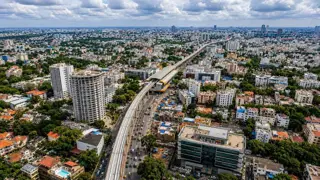
ICRA expects Bengaluru's residential area sold to grow 3-5% in FY2026 after a 52 msf first half, with new launches up 10-12% and Year-to-Sell at 1.2-1.4 years by March 2026.

Mysore Road is evolving from a transit-heavy highway into a sought-after housing corridor, where infrastructure upgrades and rising demand are reshaping values.

Smart-city corridors, airport upgrades, and rising NRI interest pushed Bhubaneswar’s residential market higher in Q3 2025, with strong mid-income sales.

Ahmedabad tops India’s furnished housing market, with 22.5% fully equipped listings, driven by relocating professionals, families, and turnkey demand.

Pune's housing market faced a sharp 31% quarterly sales drop to 15,788 units in Q4 2025, the lowest in 17 quarters. From 22,940 units in Q4 2024, this downturn signals rising inventory challenges for sellers and cautious buyers amid mixed launch trends in key submarkets like NH-4 Bypass.

Pune's residential real estate market hit 1.44 lakh property registrations from January to August 2025, up 13% from 1.27 lakh in 2024. This robust growth, fueled by IT hubs and infrastructure, positions the city to rival Mumbai and Bengaluru as India's third-largest market by 2030, per JLL and CBRE insights. Buyers flock to suburbs like Hinjewadi and Kharadi for premium homes and steady returns.

Coimbatore's housing market in Q3 2025 showed stabilization with a 3% quarter-on-quarter sales recovery despite a 7% yearly drop, per PropEquity report. Sales value across tier-2 cities hit ₹37,409 crore, up 4%, as buyers favor premium homes in post-pandemic adjustment. IT growth and infrastructure fuel optimism for future booms.

Raipur's residential property prices dropped 4% quarter-on-quarter in late 2025, per eXp India and PHC reports, signaling first correction after years of gains. Experts link it to stabilization amid rapid rises, with Chhattisgarh land prices mirroring the dip. Buyers may find opportunities as market cools.

ICRA reports Bengaluru's housing sales volume jumped 14% to 52 million sq ft in April-September 2025, fueled by mid-income and luxury demand. Steady H2 sales and 3-5% FY2026 growth projected amid resilient market trends and shifting buyer preferences toward premium homes.

South and North zones together capture 72% of Kolkata's apartment registrations, driven by affordable mid-segment housing and strong buyer demand across peripheral locations.

Ahmedabad's housing market splits sharply in H1 2025, with new launches plunging 61% YoY to 11,000 units amid 3% sales growth. Premium ready-to-move properties fetch high prices due to fierce demand, while affordable buyers face scarce options and steady rates, reshaping strategies for developers and home seekers alike.

Rangareddy district captured 47% of Hyderabad's residential registrations in October 2025, boasting the city's highest 22% year-on-year price growth. Demand for premium homes over Rs. 1 crore surged 73%, led by hotspots like Narsingi, Manikonda, and Puppalaguda, cementing its role as the real estate powerhouse amid festive momentum and infrastructure gains.

Kolkata's housing sector thrived with an 8% year-on-year price rise in Q3 2025, per Knight Frank, selling 4,374 units amid India's slowdown. It outperformed Mumbai's 7% and Pune's 5%, driven by end-user demand and steady sales, positioning the city as a resilient market hub for buyers and investors.

In Kolkata's booming real estate market as of November 2025, mid and premium residential units dominate sales and new launches, outpacing affordable housing. Buyers prioritise quality, space, and location amid infrastructure boosts in Rajarhat-New Town, Joka, and Behala, signalling a post-pandemic shift toward spacious, well-connected homes. This trend reflects rising incomes.

Shriram Properties has signed a JDA for a ₹700 crore mixed-use development in Hinjewadi, Pune, featuring 6.5 lakh sq ft of premium apartments plus retail spaces. This second project in the IT hub boosts the area's strong residential demand, with a sky clubhouse and prime location near key amenities, signaling robust growth in Pune's real estate market.

Surat surges ahead as India's fastest-growing residential market, boasting a 14.9% rise in flats for sale from January to September 2025, per eXp India's analysis. Listings climbed from 4,650 to 5,342 units, offering buyers more options and curbing sharp price hikes amid tier-2 sales dips elsewhere.

Hyderabad's residential market experienced a dramatic shift toward premium properties in Q3 2025, with luxury segments dominating new launches despite declining overall sales volumes, reflecting evolving buyer preferences.

Knight Frank's Q3 2025 report reveals Bangalore's residential prices rose 15% year-on-year, second to NCR's 19%. Anarock data back 15-20% growth in 2024. Premium areas like Sarjapur Road, Whitefield, and North Bangalore see huge demand from IT pros, startups, and NRIs, making 2BHKs under ₹1 crore scarce.

Chennai's real estate scene is transforming rapidly, with 93% of new residential launches focusing on mid, upper-mid, and luxury segments priced between ₹40 lakh and ₹2.5 crore, attracting premium buyers across key corridors.

Chennai's rental scene is heating up fast, showing 20-25% growth across many spots in just two years. Places like Pallavaram and Perambur lead with jumps of 33-40%. In Velachery, 1BHK units now go for ₹22,000 monthly, while Sholinganallur often exceeds ₹30,000. This rise makes investing in Chennai properties more attractive than ever.

The latest October 2025 report highlights a surge in available homes, villas, bungalows, and plots for sale and rent in North Goa, driven by active developers and transparent markets, ideal for buyers and investors during the festive season.

Propequity data highlights a stark supply-demand mismatch in GIFT City's residential sector, with 67% of units unsold despite total supply hitting 3,168. Prices have doubled since 2020, but high inventory questions sustainability, unlike the booming commercial market.

Mumbai's residential real estate sector showed strong momentum in Q3 2025, launching 15,388 units. Navi Mumbai led with 39% share, while mid-segment housing dominated at 65%. Capital values dipped 8%, but rentals rose slightly.

National Housing Bank data reveals Howrah experienced the steepest property price decline at 6.1% among 50 cities surveyed in Q1 FY26, contrasting with national trend.

Haryana implemented steep collector rate increases up to 50% in Panchkula from August 1, 2025, affecting over 53,000 property buyers and sparking widespread opposition from residents.