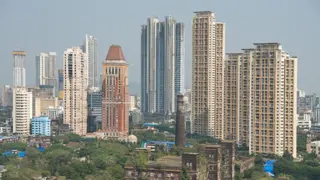
Reports in 2026 say Mumbai buyers now rank metro and sea-link connectivity, redevelopment and project quality above prestige addresses. PropertyWala data puts city apartment asking rates at ₹34,047 per sq ft.
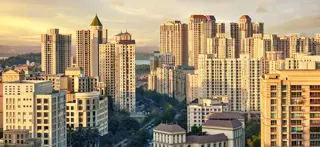
Developers expected delayed Mumbai housing projects to launch after the January 2026 civic poll, giving buyers more choice. PropertyWala data shows current apartment asking rates and projects in Borivali West.

Real estate shares fell sharply in January 2026 ahead of the Union Budget, as developers asked for faster approvals, single-window clearance and tax relief to revive affordable and mid-income housing.
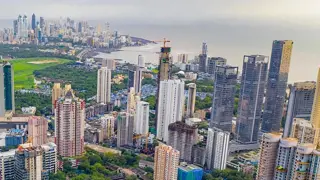
Knight Frank India says society redevelopment in Mumbai will add 44,277 free-sale homes worth ₹1.30 lakh crore by 2030, bringing in ₹7,830 crore in stamp duty and ₹6,525 crore in GST.

Lokhandwala Complex is entering a major redevelopment cycle, with older societies securing bigger flats, corpus payments, and a long runway for transformation.

NHSMRE’s third flagship conclave will explore Mumbai’s redevelopment shift, balancing feasibility, sustainability, finance, law, and infrastructure limits.

Mumbai’s property market crossed 1.5 lakh registrations in 2025, while stamp duty collections rose 11%, signaling strong end-user demand despite higher prices.

Developers are refocusing on ₹1.5–3 crore homes in 2026, reviving demand for practical housing and opening new choices for mainstream buyers.

The Supreme Court mandated a CBI investigation into Mumbai's builder-bank nexus, uncovering subvention schemes that diverted funds and delayed housing projects. Over 1,200 homes across six cities are implicated, with Supertech at the epicenter.

Mumbai’s new transport spine is lifting demand across Parel, Sewri, Panvel and select western suburbs, with value pockets still under ₹1 crore.

Mumbai's redevelopment wave is reshaping old neighbourhoods, unlocking 326.8 acres, improving safety, and drawing developers to a city short on land.

The RLDA secured a staggering ₹2,251 crore bid for 2.67 acres at Mahalaxmi on a 99-year revenue-share lease. This record auction highlights robust investor faith in South Mumbai's prime location, boosting prospects for mixed-use developments amid land scarcity and strong demand for premium properties.

Worli in Mumbai has surged as India's luxury real estate powerhouse, capturing nearly 40% of ultra-luxury home sales above ₹40 crore. Prices hit ₹1,00,000 per sq ft, rivaling New York's Lower Manhattan, with over 20 deals exceeding ₹100 crore in three years and ₹7,600 crore in land transactions since 2023. This transformation cements its status as the nation's wealth epicenter.

Mumbai's real estate surges back to pre-pandemic levels, drawing $1.2 billion in institutional investments from January to September 2025. This marks the fourth straight billion-dollar year, with domestic players at 48% and foreigners at 52%. Residential leads at $377.6 million, offices follow with $339.71 million, signaling robust recovery and investor trust.

The RBI's December 2025 repo rate cut to 5.25% is reshaping Mumbai's real estate landscape. Homebuyers in affordable and mid-income segments stand to benefit significantly from cheaper housing loans.

Bengaluru-based Sobha Ltd enters Mumbai's competitive housing market with SOBHA Inizio, a premium 1.038-acre project offering 310 luxury 1, 2, and 3 BHK apartments priced from Rs 2.8 crore to Rs 5.75 crore. Located near Atal Setu in Parel, it boasts panoramic views and top amenities. This launch follows record Q2 profits of Rs 72.52 crore and Rs 3,981.4 crore in semi-annual sales.

Mumbai's realty market has surged with institutional investments jumping fourfold to $1.19 billion in the first nine months of 2025, up from $295.57 million last year. Foreign funds from the US and Japan led with 67% share, while domestic capital added $398 million. Infrastructure boosts like Trans Harbour Link fuel this fourth straight billion-dollar year.

Pune dominated India's office market in Q3 2025, adding 3.7 million sq ft of new space, a 164% year-on-year leap per Vestian data, outshining metros like Mumbai, Bengaluru, and Delhi-NCR. Global capability centres fueled this boom amid rising demand and infrastructure gains.

Bandra Bay in Mumbai surges as a prime luxury real estate destination, boasting 46% price appreciation potential driven by ₹3.6 lakh crore infrastructure boosts and scarce land. Worli hits ₹1.2 lakh/sq.ft., Bandra West at ₹81,000, heading to ₹1.5 lakh amid ₹1 lakh crore in luxury housing and retail projects from top developers.

Mumbai's skyrocketing real estate prices mean ₹50-60 lakh budgets fetch only about 200 sq ft of space, as seen in recent sales like a 235 sq ft Dahisar studio at ₹62 lakh and a 160 sq ft Dadar flat for ₹49 lakh. Young professionals and small families turn to compact homes amid calls for Budget 2026 reforms to revise affordable housing caps and boost PMAY-U effectiveness.

Mumbai's office sector shines with 11% year-on-year rent increase, the thirteenth straight quarter of growth per Knight Frank's Q3 2025 report. Premium Grade A spaces in Nariman Point, Lower Parel, and Bandra-Kurla Complex draw strong demand as developers prioritize project completions over new launches in a supply-constrained market.

Mumbai has grabbed 32% of India's $10.2 billion real estate investments in the first nine months of 2025, showing a 14% rise year-on-year. Equity inflows jumped 48% to $3.8 billion in Q3, highlighting strong investor trust.

Mumbai's housing market saw a 17% sales decline in Q3 2025, driven by high interest rates and economic uncertainties, per Aurum PropTech. This follows a 34% drop in Q2, indicating ongoing market caution.

Despite economic hurdles like steady repo rates at 5.5% and increasing home loan EMIs, Mumbai's top micro-markets see property prices rise 8-10% yearly, per Knight Frank India. A Reuters poll forecasts urban home prices growing 6.3% in 2025 and 7% in 2026, surpassing salary increases in many areas.

Mumbai's residential real estate sector showed strong momentum in Q3 2025, launching 15,388 units. Navi Mumbai led with 39% share, while mid-segment housing dominated at 65%. Capital values dipped 8%, but rentals rose slightly.