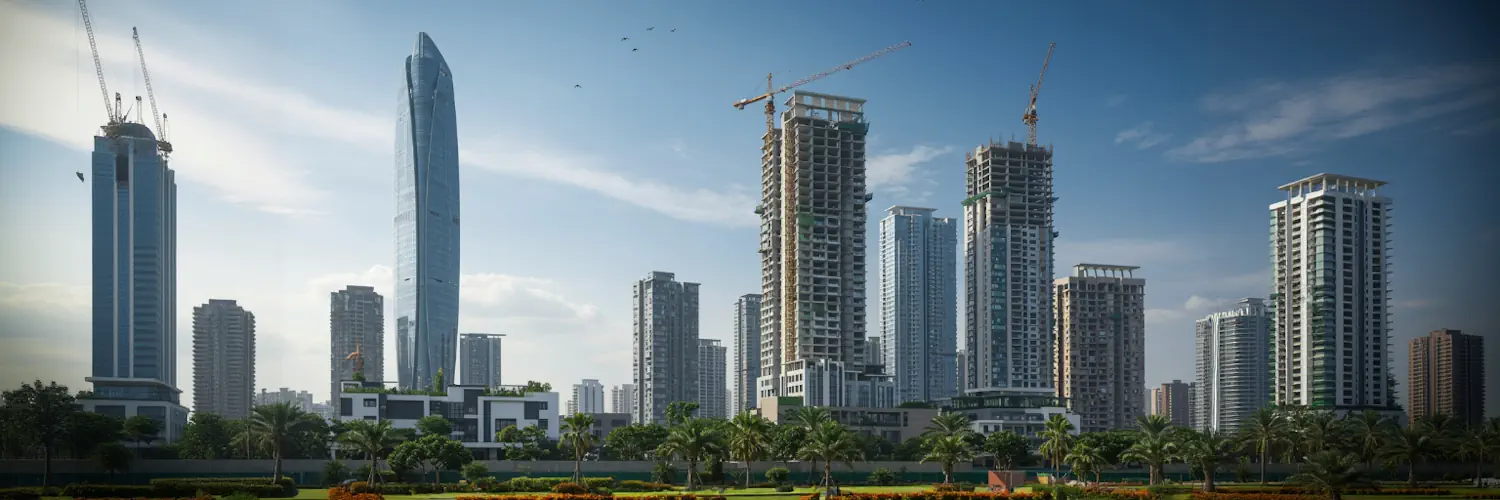
The Gera report highlights Pune’s residential market recalibrating due to 40% price hikes (5y), 25% larger homes, and a 76% entry cost surge, straining affordability.

Gurgaon's real estate market reaches ₹1.8 lakh crore, driven by infrastructure upgrades and soaring demand in residential and commercial sectors, bolstering its status as India's leading IT and business hub.

Lucknow's real estate growth accelerates through integrated townships featuring eco-friendly designs, smart amenities, and strategic expressway connectivity, supported by government initiatives across 12 districts.

Nitco and Total Environment have entered a ₹350 crore joint development agreement for plotted residential projects in Alibaug's key villages. The deal, secured with a ₹58.42 crore advance, aims to drive real estate growth in Maharashtra's Raigad district.

Non-Resident Indians have propelled a 35% surge in Coimbatore's housing demand, attracted by strategic infrastructure growth and affordable property prices.

Despite economic pressures and rising luxury inventory, Mumbai’s real estate sector remains resilient in 2025. Infrastructure development, steady price growth, and high demand for affordable homes drive sustained investor interest, reinforcing its position as India’s prime property market. Buyers and developers adapt to new trends, including fractional ownership and REITs, while emerging...

Analysts predict significant capital growth in Noida's key corridors post-2025. Strategic areas along expressways could see 25–40% price hikes as infrastructure projects near completion, offering early investors prime opportunities. Investors advised to prioritize early-stage developments in targeted zones for maximized returns.
Bengaluru-based Sattva Group announces ₹800 crore investment in South Goa's residential market, targeting luxury plots and gated communities amid growing demand and improved infrastructure.
Zirakpur's affordable properties show faster resale rates compared to Mohali's luxury segment, driven by high rental demand and co-living spaces near IT hubs.
Noida's older sectors are experiencing a sharp rise in builder and investor interest, driven by new policies allowing free area expansion and modern apartment projects, invigorating established neighborhoods.
Madurai is emerging as a key real estate hub in South India, driven by infrastructure upgrades, strategic land acquisitions, and growing interest in plotted developments. Despite national downturns, SKT Realtor reports sustained investor demand in both residential and commercial sectors, supported by affordability and economic growth.

A ₹23,000 crore semiconductor chip plant is coming to Mysore, promising to create thousands of jobs and boost demand for residential and commercial properties.

Chandigarh's real estate association condemns proposed collector rate hikes, citing threats to affordability and stalled market growth due to existing registration bans.

Nashik's strategic positioning between Mumbai and Pune, combined with upgraded infrastructure and air connectivity, accelerates residential and commercial real estate growth, attracting investors and homebuyers seeking affordability and accessibility in 2025.

Dehradun’s real estate surge is driving ecological damage, loss of green spaces, and rising temperatures. Experts call for sustainable urban planning, heritage conservation, and climate resilience amid rapid development.

CREDAI Mangalore and SI-8 form a partnership to transform real estate through innovation and sustainability, setting new standards in green building and urban development.

Ahmedabad’s real estate market saw a 7.7% drop in new projects during FY 2023-24, driven by increased construction costs and a surge in urban redevelopment.
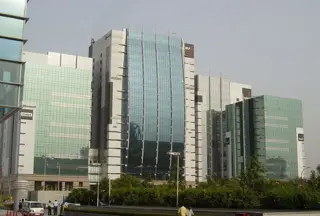
A major developer announces plans for Gurgaon's largest mixed-use development, spanning 1,000+ acres with residential, commercial, retail spaces, and a dedicated start-up hub, set to reshape New Gurgaon's skyline.

Mohali's real estate market attracts NRIs through RERA reforms and streamlined services, offering luxury homes and smart offices with end-to-end dealer support.

Institutional investment in Indian real estate to grow by 14.6% to Rs 395 billion in 2021, driven by optimism in commercial office assets.
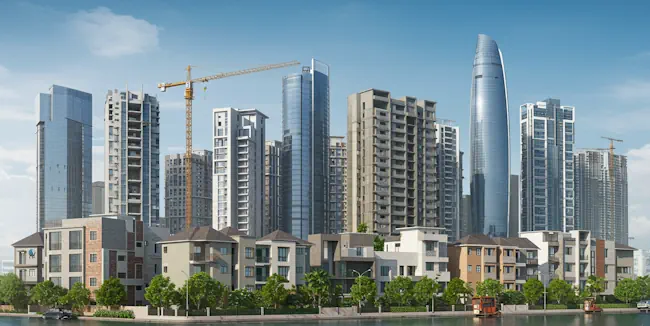
The GROHE-Hurun India Real Estate 100 list highlights India's booming real estate market, driven by economic growth and investment, surpassing China in growth rate.

Indian real estate anticipates Union Budget 2024 to address key reforms. Industry leaders seek reduced construction costs, industry status, and single-window clearance to boost growth and achieve the projected $1 trillion market size by 2030.
The Indian real estate market sees a revival with institutional investments reaching $2.5 billion in Q2 2024, driven by foreign investors and strong growth in industrial and residential sectors.
JLL reports 56 Joint Development Agreements (JDAs) signed between landowners & developers in India, covering 1,546 acres, with 97% for residential projects, from Jan 2023 to Jun 2024.
India's emerging real estate hotspots are set to play a crucial role in the nation's economic growth, driven by infrastructure developments and tourism, according to Colliers' report.